

Updated November 2026 with the en primeur verdict.
The 2025 Bordeaux vintage turned out to be excellent and very small. Most critics, after tasting the young wines from barrel in the spring of 2026, placed 2025 among the best Bordeaux vintages of recent years. Decanter gave it a preliminary 4.5 out of 5, and critics have compared it to great years like 2016, 2019 and 2020. It is also the smallest Bordeaux crop since 1991, with yields around half of a normal year, which means that, while excellent, the best wines will be scarce.
That said, not every estate succeeded. Some critics found quality uneven, with the best results coming from old vines, cooler clay and limestone soils, and careful picking. Many châteaux released their wines at lower prices than in recent years, although some merchants felt only a handful priced them low enough to truly tempt buyers.
- Quality: excellent at the top, uneven elsewhere
- Size: the smallest crop since 1991
- Style: ripe and concentrated, yet many wines are fresher and more elegant than the hot summer suggested
- Harvest: among the earliest ever, with some white grapes picked in mid-August
- Cellaring: plan to keep the top reds for at least a decade
A Vintage Born of Heat and Resilience
The 2025 growing season in Bordeaux will be remembered for one defining trait: heat.
From Saint-Émilion to the Médoc, vignerons faced a summer of record temperatures, scarce rainfall, and some of the earliest harvests ever recorded. Yet, despite the challenges, many are calling 2025 a “remarkable” and potentially great vintage; rich, structured, and deeply expressive of terroir.
Wine consultants like Hubert de Boüard and Simon Blanchard have described it as a “marathon vintage”, one that tested the endurance of vines and vignerons alike, but could reward them with wines of exceptional character if balance is achieved.
Seasonal Weather
Spring – Early and Dry
After a mild winter that replenished groundwater, spring arrived early and dry, setting the stage for quick budburst and flowering.
According to Météo-France, spring temperatures were well above normal, and rainfall was well below average after April.
The result was uniform flowering, low disease pressure, and an optimistic start to the season.
Summer – Heat and Stress
By mid-June, the heat was on, quite literally. June 2025 was one of the hottest ever recorded in France, second only to 2003.
Bordeaux vineyards saw weeks above 95°F, with temperatures peaking around 107°F during the mid-August heatwave.
As Le Figaro Vin reported, “the heat wave blocked berry growth,” resulting in smaller grapes and reduced yields, but greater concentration.
Despite the stress, disease remained nearly absent, a silver lining after several recent years of mildew challenges. “Two small rainfalls in August would have saved 5–10% yield,” one grower told Vitisphere.
August & September – Early Harvest
The heat pushed ripening forward, leading to the earliest harvests ever recorded at top estates like Château Troplong Mondot, which began picking on August 28, nearly two weeks ahead of schedule.
Luckily, late August and early September brought stable, dry, and cool nights, creating near-perfect conditions for harvesting.
Regional Highlights
Right Bank: St-Émilion, Pomerol, Fronsac
Clay and limestone soils on the Right Bank provided the area with natural resilience. In Saint-Émilion, vines retained good freshness despite the heat, producing small, aromatic berries.
In Pomerol, some estates delayed harvest slightly to ensure full phenolic ripeness, risking higher alcohol but gaining texture and depth.
Overall, expect deep color, supple tannins, and ripe Merlot fruit balanced by minerality from the region’s cooler nights.
Left Bank North: Médoc, Margaux, Pauillac, St-Estèphe
The gravelly soils that define the Left Bank enhanced drought stress during the summer.
Younger vines struggled, but old Cabernet Sauvignon vines with deep roots thrived.
Cool Atlantic breezes helped preserve acidity, especially in Margaux and Saint-Julien.
Expect structured, age-worthy reds with dense tannins, reminiscent of 2022 but slightly fresher.
Left Bank South: Graves and Pessac-Léognan
Early drought slowed vegetative growth, but dry whites show excellent promise.
Sauvignon Blanc and Sémillon reached aromatic maturity without disease, producing crisp yet ripe wines with notes of tropical fruit.
Sweet Regions: Sauternes and Barsac
For the sweet wine regions, the story is more uncertain. The absence of late-summer humidity could limit the development of Botrytis cinerea (noble rot), which is essential for the production of classic Sauternes.
In the end, picking in Sauternes and Barsac began around September 20, with pickers making several passes through the vines. Volumes are small and quality varies by estate.
2025 Harvest Size and Quality
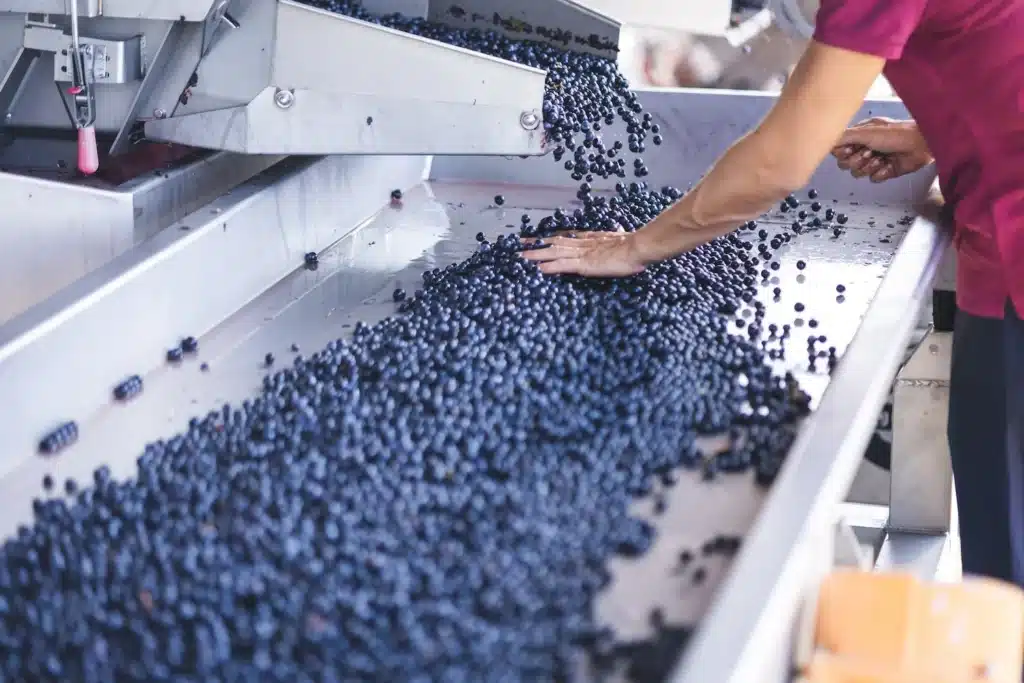
The 2025 harvest was the smallest in Bordeaux since 1991, about half the volume of the 2016 vintage.
Yields rarely rose above 30 hectolitres per hectare, around half of what an estate expects in a normal year, because the heat and drought left fewer bunches and smaller berries. With almost no disease, though, what was picked was very healthy.
Yet, what’s lost in quantity may be gained in quality. The Conseil Interprofessionnel du Vin de Bordeaux (CIVB) confirmed the grapes were “small but perfectly healthy,” with excellent ripeness and color intensity.
| Style | Expected Character | Verdict |
|---|---|---|
| Red Wines | Deep color, rich tannins, moderate acidity, and aromatic concentration | Excellent at top estates, compared with 2016, 2019 and 2020 |
| Dry Whites | Ripe tropical fruit, good aromatic freshness, lower acidity | Very good: Stylistically ripe and expressive |
| Sweet Wines | Limited botrytis, possibly fewer dessert cuvées | Small volumes, varies by estate |
| Overall Vintage | Concentrated, balanced, and precise if well-managed | Excellent but tiny: Decanter 4.5/5 (preliminary) |
Winemakers summarize 2025 as a year of “precision viticulture” where timing, canopy management, and harvest decisions mattered more than ever.
As Vitisphere put it, “the vines ran a marathon, not a sprint.”
The 2025 Bordeaux vintage stands as both a testament to the region’s adaptability and a glimpse into the future of winemaking under a warming climate.
Vines that endured the summer heat yielded smaller, deeply flavored grapes, the kind that make memorable wines when handled with care.
Whether you favor the plush Merlots of Saint-Émilion or the structured Cabernets of Pauillac, 2025 promises wines of density, precision, and personality, if in limited quantities.
The 2025 wines are now aging in barrel and most will be bottled in 2027. Some châteaux offer barrel tastings, a rare chance to taste a young vintage next to older ones.
Visiting around harvest time? See our Bordeaux harvest experience, or see how 2025 compares in our Bordeaux vintage chart.
Sources:
- Gavin Quinney, “Bordeaux 2025 Weather and Crop Report”
- Decanter, “Bordeaux 2025: The vintage verdict and top-scoring wines”
- The Drinks Business, “Bordeaux 2025 vintage profile: Quality over quantity“
- Vitisphere, “2025 a tout d’un très grand millésime à Bordeaux” (July 2025)
- Vitisphere, “2025 grand millésime en cinq points clés pour les vins de Bordeaux” (Sept 2025)
- Le Figaro Vin, “Les quantités de vin produit en 2025 revues à la baisse” (Oct 2025)
- Météo-France, “Bilans climatiques 2025”
- Le Monde, “Canicule: les températures supérieures à 40 °C se banalisent” (Aug 2025)
- Decanter, “Classified St-Émilion Estate Begins Earliest Ever Harvest” (Aug 2025)
- Reuters, “Hot, Dry Weather Seen Pushing French Wine Output Below Five-Year Average” (Sep 2025)