

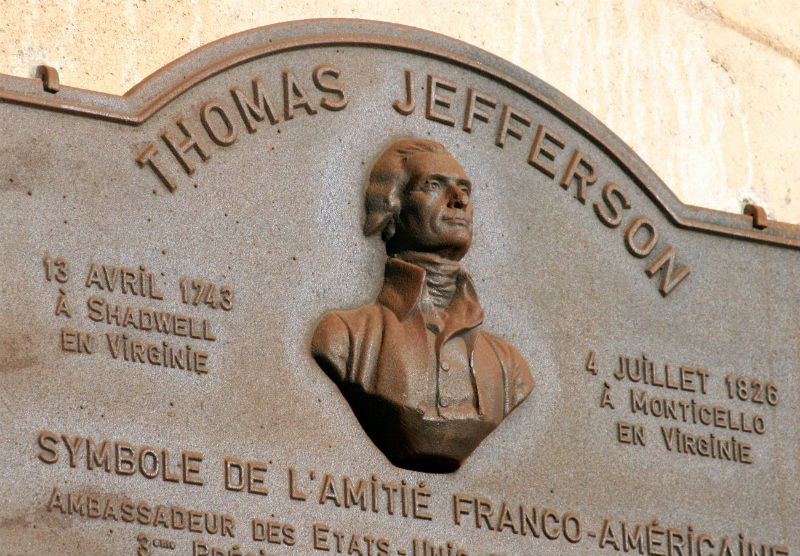
Thomas Jefferson served as America’s minister to France from 1785 to 1789. His travels through Bordeaux in 1787 are one of the great Thomas Jefferson Bordeaux stories, and they would help shape the early American appreciation for fine wine.
We all know that Thomas Jefferson is best known as a Founding Father and America’s third president, but wine lovers know him for something else.
In 1787, Jefferson traveled through Bordeaux to understand why the region’s wines had become some of the most sought-after in Europe.
He visited vineyards, met merchants, compared prices, took extensive notes, and purchased wines for his own cellar. The trip itself was brief, but its impact on American wine culture lasted forever.
Jefferson returned home convinced that Bordeaux produced some of the finest wines in the world. He ordered barrels for his own cellar, recommended them to friends, and helped establish Bordeaux as the benchmark for fine wine among educated Americans.
Today, nearly 240 years later, American visitors still arrive in Bordeaux carrying a curiosity that traces back to Jefferson’s footsteps.
Why Did Thomas Jefferson Visit Bordeaux?
In 1787, Jefferson was serving as the American minister to France, a position roughly equivalent to ambassador.
Based in Paris, he spent much of his time traveling throughout Europe. These journeys were rarely simple sightseeing excursions. Jefferson was constantly gathering information that he believed could benefit the United States. He studied farming methods, manufacturing, architecture, transportation networks, and trade. Wine was part of that larger educational mission.
At the time, Bordeaux was already one of Europe’s most important wine regions. Its wines were exported across Britain, northern Europe, and the Americas. Wealthy consumers in London considered the best Bordeaux wines symbols of refinement and good taste.
Jefferson wanted to understand why. Rather than relying on merchants’ claims, he decided to visit the vineyards himself.
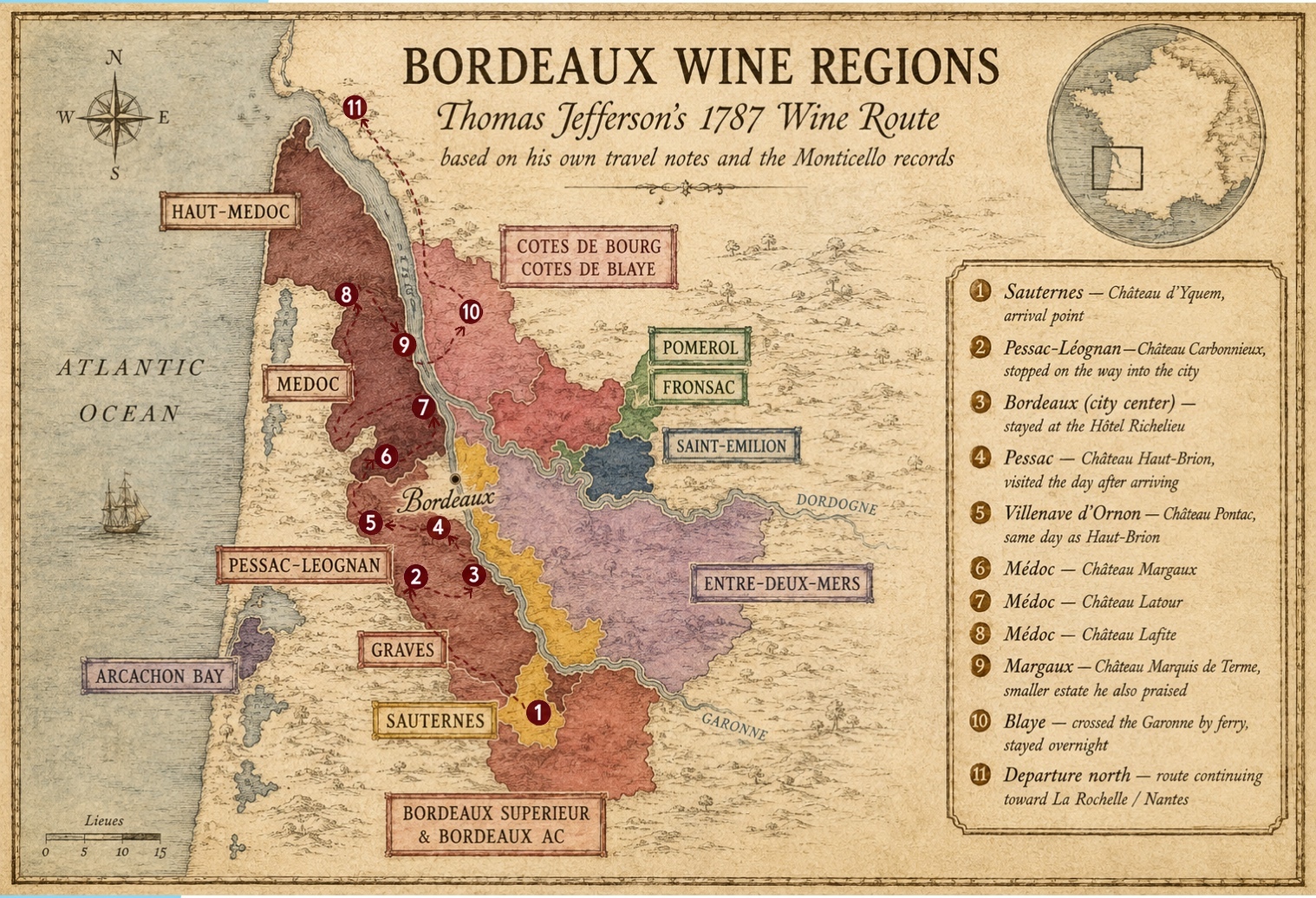
The Thomas Jefferson Bordeaux Tour of 1787
Jefferson arrived in Bordeaux in May 1787.
From the city, he set out on horseback to explore the vineyards of the Médoc. Bordeaux looked very different in those days. There were no tasting rooms, visitor centers, or organized wine tours. Most estates were focused entirely on growing grapes, making wine, and selling it through merchants.
Jefferson wasn’t visiting Bordeaux as a tourist. He was trying to understand why some wines consistently sold for more than others and why certain estates had earned such strong reputations. Much of his route followed what is now known as the Route des Châteaux.
Today, it’s one of the most famous wine roads in the world. In Jefferson’s time, it was simply a collection of country roads connecting vineyards, villages, and wine-producing estates along the Gironde estuary.
Visitors driving through Margaux, Saint-Julien, Pauillac, and Saint-Estèphe today are often surprised by how much of the landscape still feels familiar.
The roads have improved. The estates welcome visitors. But the vineyards remain.
The gravel ridges are still there. The Gironde still shapes the climate. And many of the names Jefferson encountered continue to define Bordeaux wine today. Jefferson paid close attention to everything he saw.
His notebooks contain observations about vineyard locations, soil types, prices, production methods, and reputation.
He wasn’t simply tasting wine. He was trying to understand why certain vineyards consistently earned higher reputations than others.
Did Thomas Jefferson Create His Own Bordeaux Classification?
Jefferson never created an official classification. Yet, his notes show that he was already identifying Bordeaux’s leading estates and comparing the region’s leading wines according to reputation, quality, and price, decades before the region’s official classification system in 1855.
His notes placed several familiar names at the top of Bordeaux’s hierarchy, including Lafite, Latour, Margaux, and Haut-Brion.
Looking back today, the similarities are striking. Many of the estates Jefferson identified as Bordeaux’s finest remain among the region’s most respected producers. The observations of a curious traveler trying to understand Bordeaux’s wine trade offer a rare look at Bordeaux decades before Napoleon III commissioned the classification that wine lovers still reference today.
What Bordeaux Wines Did Jefferson Buy?
Jefferson did not simply taste Bordeaux wines. He purchased them.
Wine had to be transported carefully from Bordeaux to ports, loaded onto ships, and carried across the Atlantic. Breakage, spoilage, and delays were constant concerns.
Extensive records show orders for wines from some of the region’s most celebrated estates, including Haut-Brion, Lafite, and Yquem.
His cellar became one of the most sophisticated collections in early America. Among his favorites was Château d’Yquem, the famous sweet wine from Sauternes. Jefferson ranked it among France’s finest wines and purchased 250 bottles of the 1784 vintage for himself, and additional bottles for George Washington. Today, visitors can still tour the estate and taste wines from the same region that impressed a man who would later help shape America’s appreciation for fine wine.
Why Did Jefferson Want Americans to Drink Wine?
Jefferson believed wine served an important social purpose.
He viewed moderate wine consumption as healthier and more civilized than excessive consumption of distilled spirits. This belief reflected broader European attitudes he encountered during his years abroad.
In letters and conversations, Jefferson frequently expressed hope that Americans would develop a stronger appreciation for wine.
He was not advocating luxury for its own sake. Rather, he believed wine encouraged moderation, conversation, and cultural exchange. Jefferson helped introduce many Americans to the idea that wine could be appreciated intellectually as well as socially.
How Bordeaux Influenced Early American Society
In the decades following independence, Bordeaux wines gained a reputation among diplomats, politicians, merchants, and educated professionals.
Part of that reputation stemmed from practical realities. Imported Bordeaux was expensive and difficult to obtain. But another factor was Jefferson himself. As one of America’s most respected public figures, his opinions carried considerable weight.
The wines he recommended often became the wines others wanted to serve. And gradually, Bordeaux became associated with education, international experience, and sophisticated taste among America’s early elite.
Why Americans Still Connect With Jefferson’s Bordeaux Story
The Thomas Jefferson Bordeaux story resonates because it offers a familiar starting point for understanding the region.
Unlike many historical figures, Jefferson left behind detailed travel notes that allow readers to follow his observations almost step by step. His writings transform Bordeaux from an abstract wine region into a real place filled with roads, vineyards, merchants, and conversations.
Jefferson was not born into French wine culture. He approached Bordeaux as an outsider trying to understand what made the region special.
Many visitors today are asking the same questions. Why do these vineyards matter? What makes one château different from another? Why have these wines remained influential for centuries?
Jefferson’s notes provide a bridge between eighteenth-century Bordeaux and the modern visitor experience.
Can You Still Follow Thomas Jefferson’s Bordeaux Route Today?
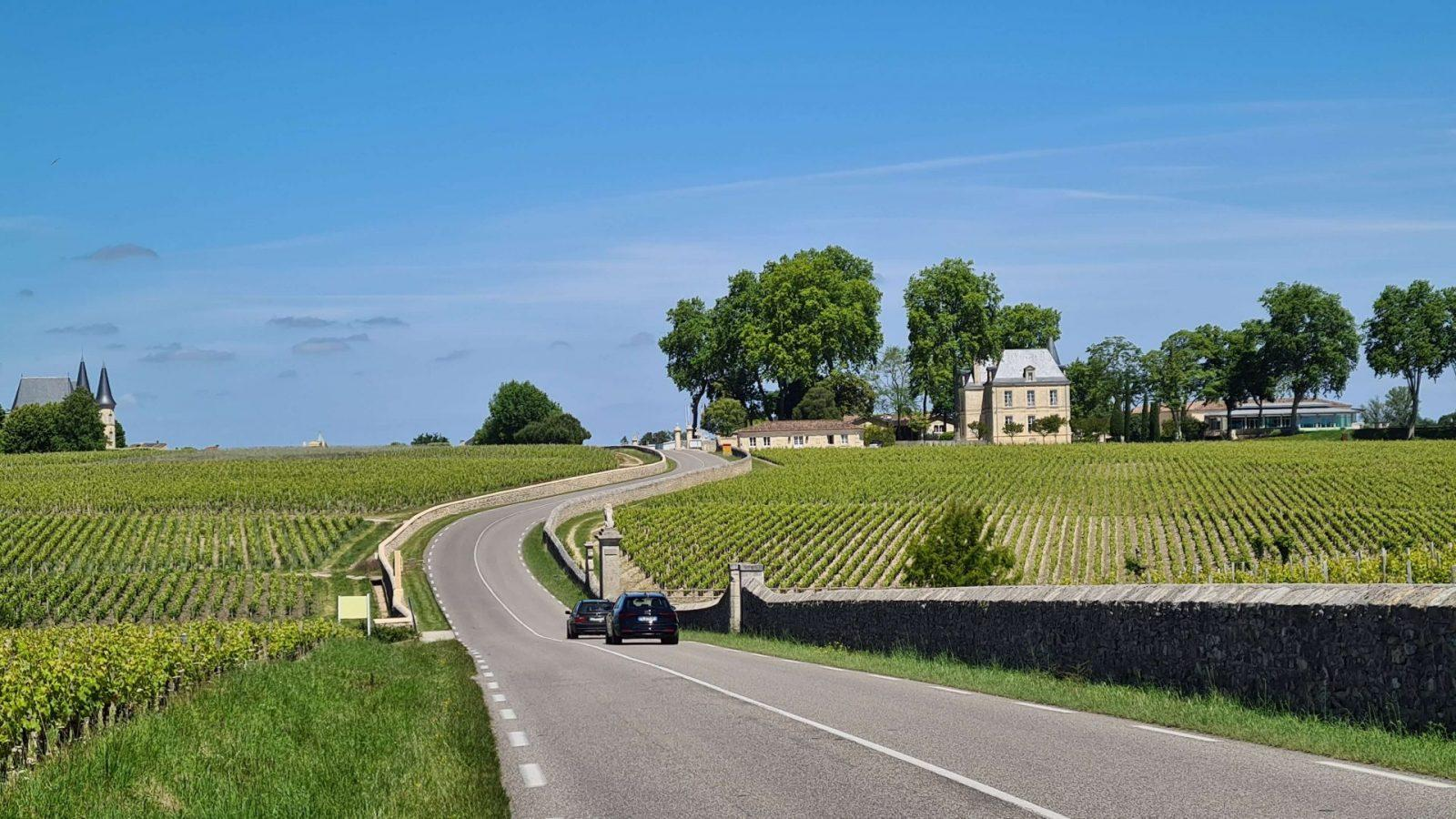
Much of the landscape Jefferson saw in 1787 remains recognizable today along the Route des Châteaux in the Médoc.
Visitors can drive the modern Route des Châteaux through the Médoc, passing renowned appellations such as Margaux, Pauillac, Saint-Julien, and Saint-Estèphe.
Many of the great estates Jefferson admired continue producing wine today.
South of the city, visitors can explore Pessac-Léognan, home to Château Haut-Brion and the gravel soils that caught Jefferson’s attention nearly two and a half centuries ago.
Of course, the experience has changed. Jefferson traveled on horseback and relied on handwritten notes. Today’s visitors enjoy guided tastings, private château visits, and comfortable transportation between estates.
The reasons people come, however, haven’t changed all that much. The vineyards still stretch across the same gravel ridges. The Gironde estuary still shapes the climate. And the wines continue reflecting the landscapes that fascinated Jefferson in 1787.
For many American travelers, following Jefferson’s route adds an extra dimension to a Bordeaux visit. It transforms a wine trip into a story about curiosity, learning, and the long relationship between America and one of the world’s most celebrated wine regions.
More than two centuries after his visit, the Thomas Jefferson Bordeaux connection remains one of the most influential in American wine history. His observations helped introduce generations of Americans to the region’s wines and established a connection that continues today.
For visitors walking through a château courtyard or tasting a glass of Bordeaux while looking across the vineyards, it is not difficult to understand why Jefferson was captivated.
The landscapes that impressed him are still here, so are many of the wines.
Perhaps that’s why Jefferson’s Bordeaux story still feels relevant to so many American travelers today.
Sources
- The Papers of Thomas Jefferson (founders.archives.gov)
- Thomas Jefferson Foundation, Monticello (monticello.org)
- Stephen Brook, The Complete Bordeaux (Bordeaux Wine Enthusiasts)
- Château d’Yquem Historical Archives (Time capsule)